30 Jul 2026
Whistle Trends: How Official Appointments Alter Betting Landscapes in Football's Elite Competitions

Referee assignments in major European leagues and continental tournaments create measurable shifts in betting markets because each official brings distinct patterns in foul detection, card issuance, and time management. Data from the past five seasons shows that certain referees average 5.8 yellow cards per game while others hover near 3.2, directly influencing over/under card lines and player prop markets across the Premier League, La Liga, Serie A, and the UEFA Champions League.
Appointment schedules released by league authorities typically appear 48 to 72 hours before kickoff, giving bettors a narrow window to adjust positions. Analysts track historical performance metrics for each referee, including average stoppage time, penalty awards per 90 minutes, and strictness on simulation. These figures feed into models that recalculate odds within minutes of an announcement, particularly for matches involving teams that rely on high-pressing styles or set-piece volume.
Referee Profiles and Market Reactions
Observers note that appointments involving officials with elevated foul thresholds often push totals markets higher in both corners and cards because play continues longer without interruptions. In contrast, referees known for quick interventions compress those same lines while elevating anytime card props on aggressive midfielders. One documented case from the 2024-25 Champions League group stage showed a 12 percent swing in over-4.5 cards odds within 90 minutes of a stricter official's assignment to a fixture between two high-tempo sides.
European federations publish referee performance reports that detail these tendencies, allowing data teams to build comparative tables. The reports include metrics such as average added time in the second half and the ratio of home versus away penalties awarded. Bettors who cross-reference these reports with team tactical profiles gain edges in live markets when early decisions deviate from expected patterns.
Impact on Specific Betting Verticals
Card-based markets experience the clearest movement after appointments become public. Strict referees push player card props and team card totals upward, while lenient officials compress those lines and boost corner and goal lines because fewer stoppages occur. Penalty markets also shift, especially when referees with higher award rates are assigned to matches featuring teams that draw frequent fouls inside the box.
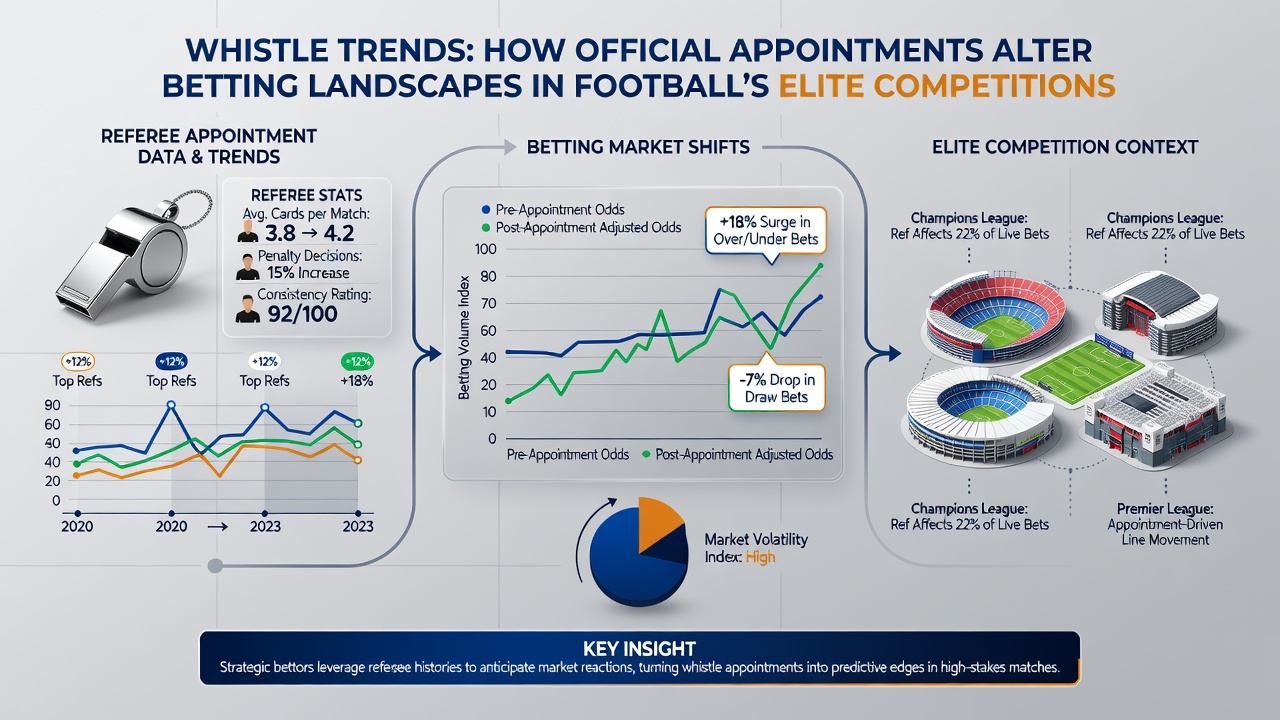
Added-time markets react to referees who consistently extend games beyond five minutes in the second half. Teams trailing late in matches see their live draw odds improve when such officials are on the field, creating opportunities for in-play traders who monitor exact stoppage patterns rather than relying on average league figures.
Seasonal Patterns Emerging in 2026
July 2026 marks the start of new referee rotation policies across several top leagues, with governing bodies introducing stricter limits on consecutive high-profile assignments for individual officials. Early indications suggest these changes will distribute card-heavy referees more evenly, reducing the frequency of extreme line movements that previously clustered around certain calendar weeks. Industry reports from the European Sports Betting Association indicate that operators have already adjusted their risk models to account for greater rotation and fewer repeat appointments in consecutive matchweeks.
Academic studies from institutions such as the International Centre for Sports Studies have examined referee consistency across borders, finding that cross-league appointments in UEFA competitions produce different behavioral baselines than domestic fixtures. These differences appear most pronounced in the first half, when officials adjust to unfamiliar playing styles and crowd dynamics.
Operational Adjustments by Bookmakers
Operators monitor appointment feeds through official league channels and third-party data providers, updating odds engines automatically when referee identities are confirmed. Some platforms now display referee-specific statistics directly on pre-match pages, allowing users to see average cards, penalties, and added time at a glance. This transparency has narrowed the window for sharp bettors who previously relied on private databases, yet it has also increased overall market liquidity around those lines.
Training programs run by professional referee organizations emphasize consistency, yet natural variation remains because each match context differs. Data aggregators continue to refine their models by incorporating variables such as weather, fixture congestion, and travel distance, all of which interact with individual referee tendencies to shape final outcomes.
Conclusion
Referee appointments function as a structural input that reshapes multiple betting markets in elite football competitions. Historical performance data, combined with transparent scheduling, enables systematic tracking of how each official influences cards, penalties, corners, and stoppage time. As rotation policies evolve through 2026, market participants will continue adapting their approaches to account for more balanced distributions of referee profiles across the calendar.